Why Temperature and Timing Matter
Baking is chemistry. Unlike cooking where you can taste and adjust, pie baking requires precision from the start. Get the temperature wrong and you’ll have:
- Too hot: Burnt edges, raw center, tough pastry
- Too cool: Pale crust, soggy bottom, undercooked filling
- Wrong timing: Overbaked and dry OR underbaked and raw
The truth: Most home baking failures come from temperature/timing issues, not the recipe itself!
Understanding Your Oven
Oven Temperature Reality Check
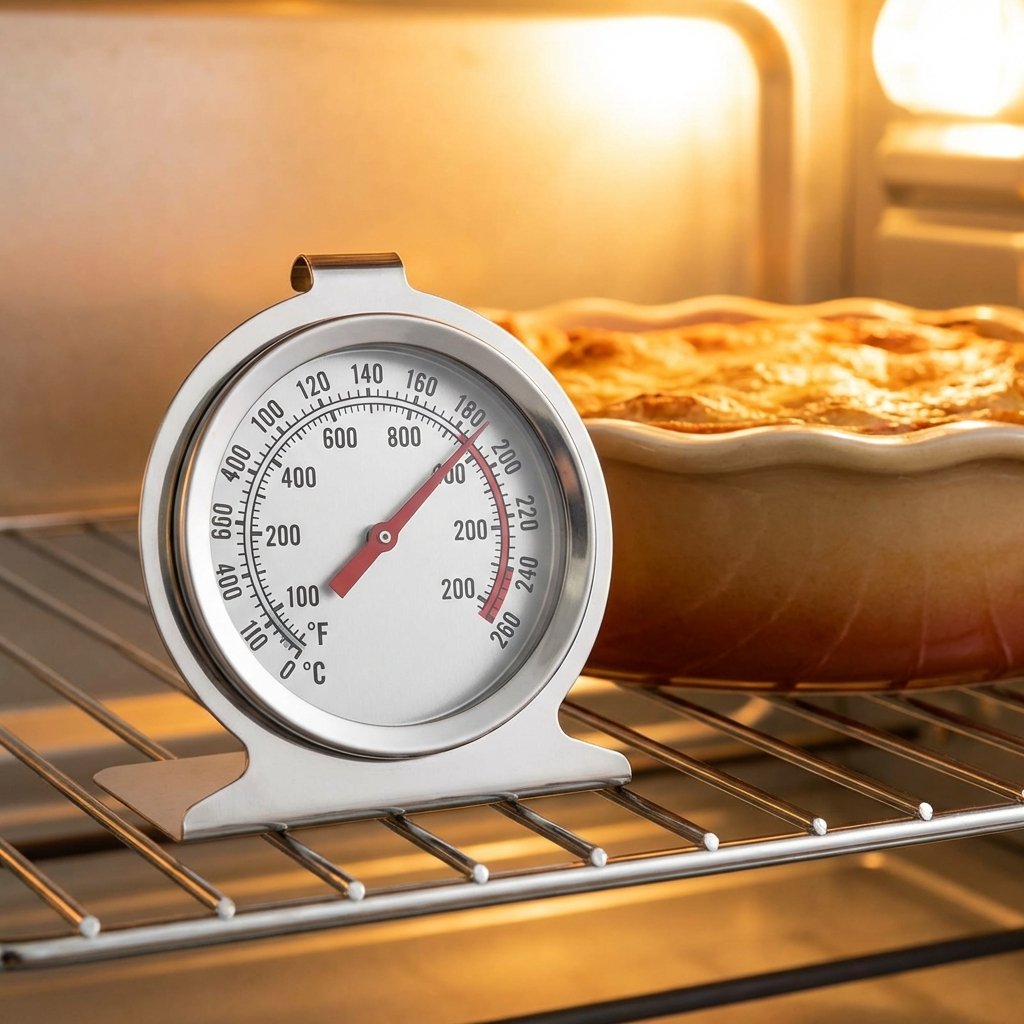
Sobering fact: Most home ovens are inaccurate by 10-25°C!
Andy’s essential tool: Oven thermometer ($15-25)
- Hang it on middle rack
- Check against dial setting
- Know your oven’s quirks
Common oven issues:
- Runs hot: Reduce recipe temp by 10-15°C
- Runs cool: Increase temp or extend time
- Hot spots: Rotate pies halfway through baking
- Temperature swings: Avoid opening door frequently
Oven Types and How They Affect Baking
Conventional (Top & Bottom Heat):
- Best for: Traditional pies, even browning
- Rack position: Middle for balanced heat
- Pros: Reliable, predictable
- Cons: Slower than fan-forced
Fan-Forced (Convection):
- Temperature adjustment: Reduce by 20°C from conventional recipes
- Best for: Multiple pies at once, faster cooking
- Pros: Even heat distribution, faster cooking
- Cons: Can dry out pastry if too hot
Top Heat Only:
- When to use: Browning cheese on savory pies (last 5 mins)
- Risk: Burns top before bottom cooks
- Andy’s tip: Only for finishing, never full baking
Bottom Heat Only:
- When to use: Crisping soggy bottoms
- How: Last 10 minutes of baking
- Setup: Move to lowest rack, reduce temp by 20°C
The Perfect Pie Baking Temperature Guide
Pastry Baking Temperatures
High Heat (200-220°C / 390-425°F):
- Best for: Puff pastry, blind baking, initial burst
- Why: Creates steam quickly = maximum puff
- Duration: First 15-20 minutes
- Watch for: Fast browning, cover if needed
Medium-High (180-200°C / 355-390°F):
- Best for: Double-crust fruit pies, savory pies
- Why: Cooks filling through while browning crust
- Duration: Majority of baking time
- Ideal: Most reliable temperature range
Medium (160-180°C / 320-355°F):
- Best for: Custard pies, delicate fillings, finishing
- Why: Gentle heat prevents curdling
- Duration: After initial high-heat start
- Examples: Pumpkin pie, quiche, chess pie
Low (140-160°C / 285-320°F):
- Best for: Meringue toppings, slow-baked custards
- Why: Sets without browning or weeping
- Duration: Final 15-30 minutes
- Rare: Only for specific techniques
The Two-Temperature Method (Professional Secret)
What it is: Start hot, finish cooler
Why it works:
- High heat (220°C) for 15-20 mins: Sets pastry, creates golden color
- Reduced heat (180°C) for remaining time: Cooks filling gently, prevents burning
Best for:
- Double-crust fruit pies
- Deep-dish pies with lots of filling
- Any pie that needs extended baking time (45+ minutes)
Example: Apple Pie
- 0-15 mins: 220°C (425°F) - Sets and browns crust
- 15-60 mins: 180°C (355°F) - Cooks apples through without burning edges
Timing by Pie Type
Quick Reference Chart
| Pie Type | Temp (°C) | Time | Doneness Test |
|---|---|---|---|
| Blind-baked shell | 200 | 20-25 mins | Deep golden, firm |
| Quiche | 180-190 | 35-45 mins | Set edges, slight jiggle center |
| Fruit pie (single crust) | 190-200 | 40-50 mins | Bubbling filling, golden crust |
| Fruit pie (double crust) | 220→180 | 50-70 mins | Filling bubbles through vents |
| Pumpkin/custard | 190→160 | 50-60 mins | Edges set, center jiggles |
| Chicken pot pie | 200 | 40-50 mins | Filling bubbles, golden top |
| Puff pastry | 200-220 | 20-30 mins | Deep golden, doubled in height |
| Shepherd’s pie | 180-190 | 25-35 mins | Crispy potato top |
Detailed Timing Guidelines
Fruit Pies (50-70 minutes total):
- 0-15 mins: High heat for crust color
- 15-50 mins: Reduced heat to cook fruit
- Signs of doneness:
- Filling actively bubbling through vents
- Crust deep golden brown
- Juice thickened (not watery when you peek)
Custard Pies (50-60 minutes):
- 0-15 mins: Medium-high to set crust
- 15-50 mins: Medium to gently cook custard
- Signs of doneness:
- Edges completely set
- Center 2-3 inches still jiggles like jelly (not liquid)
- Internal temp: 175-180°C
Savory Pies (40-50 minutes):
- 0-15 mins: High heat for pastry
- 15-40 mins: Medium-high for filling
- Signs of doneness:
- Filling bubbles at edges
- Crust golden brown
- Internal temp: 75°C minimum
Puff Pastry (20-30 minutes):
- Entire bake: High consistent heat
- Signs of doneness:
- Puffed to 2-3x original height
- Deep golden color (not pale!)
- Sounds hollow when tapped
- Layers fully separated
Testing for Doneness (Beyond Time)
Time is a guide, not a rule! Ovens vary. Always use visual and physical cues.
Visual Cues
Crust:
- ✅ Deep golden brown (not pale beige!)
- ✅ Edges darker than center (natural)
- ✅ No raw-looking dough visible
- ❌ Pale = underbaked
- ❌ Black = overbaked
Filling:
- ✅ Bubbling through vents (fruit pies)
- ✅ Set but jiggly center (custard pies)
- ✅ Bubbling at edges (savory pies)
- ❌ Liquid = underbaked
- ❌ Dried/cracked = overbaked
Physical Tests
The Jiggle Test (Custard Pies):
- Gently shake pie
- Edges should be completely set
- Center 2-3 inches should jiggle like jelly
- If waves across entire surface = too liquid, bake longer
- If no movement = overcooked
The Knife Test:
- Insert knife 2 inches from center
- Should come out mostly clean (slight moisture OK)
- Crumbs = done, wet batter = not done
The Thermometer Test (Most Accurate):
- Instant-read thermometer into center of filling
- Fruit pies: 90-95°C (filling thickened)
- Custard pies: 175-180°C (set but not curdled)
- Savory pies: 75°C minimum (safe to eat)
The Tap Test (Puff Pastry):
- Tap bottom gently with knuckles
- Should sound hollow, not thud
- Thud = still doughy inside
Common Timing Mistakes
❌ Opening oven too frequently
- Each opening drops temp by 10-15°C
- Extends baking time by 5+ minutes
- Causes uneven baking
Fix: Only open when necessary (rotation, testing at minimum time)
❌ Not preheating long enough
- Oven needs 15-20 minutes to fully heat
- Starting in cold oven = pale, undercooked pastry
Fix: Preheat for 20 minutes minimum, verify with thermometer
❌ Baking on wrong rack
- Too high = burnt top, raw bottom
- Too low = burnt bottom, pale top
Fix:
- Most pies: Middle rack (balanced heat)
- Crispy bottoms: Lower third
- Extra browning: Upper third (watch carefully!)
❌ Not rotating halfway through
- Oven hot spots cause uneven browning
- One side overcooked, other undercooked
Fix: Rotate 180° at halfway point
❌ Following recipe times blindly
- Your oven ≠ recipe developer’s oven
- Altitude, humidity, pan material all affect timing
Fix: Use time as guide, trust visual/physical cues
Advanced Timing Techniques
The Extended Rest Method (Custard Pies)
Problem: Center still jiggly but edges overcooking
Solution:
- Bake until edges set, center jiggles significantly
- Turn OFF oven
- Leave pie in oven with door closed for 15-30 minutes
- Residual heat gently finishes center without overcooking edges
Best for: Pumpkin pie, quiche, chess pie
The Shielding Method (Long Bakes)
Problem: Edges browning too fast during long bake
Solution:
- Start uncovered
- At 30 minutes, check edges
- If browning fast, apply foil shield
- Continues baking filling while protecting crust
How to shield:
- Cut center from foil square, create ring
- OR use silicone pie shield ($10)
- OR tent loosely with foil
The Finish-on-Lower-Rack Method
Problem: Top golden but bottom still pale/soggy
Solution:
- Bake on middle rack as usual
- Last 10-15 minutes, move to lowest rack
- Direct bottom heat crisps base
- Reduce temp by 20°C to prevent burning top
Best for: Quiche, single-crust fruit pies, custard pies
The Resting Period (Critical!)
Why rest matters:
- Filling continues cooking from residual heat
- Juices thicken as they cool
- Slicing hot pie = runny filling disaster
Resting times:
- Fruit pies: 3-4 hours minimum (overnight is best!)
- Custard pies: 2 hours + chill in fridge
- Savory pies: 15-30 minutes
- Puff pastry: 10 minutes (eat while warm!)
Andy’s rule: Patience at the end is just as important as patience during baking!
Troubleshooting Temperature & Timing Issues
Problem: Pie Always Underbaked
Likely causes:
- Oven runs cool
- Not preheating long enough
- Opening door too frequently
- Incorrect rack position
Solutions:
- Buy oven thermometer, adjust temp up
- Preheat 20+ minutes
- Only open when necessary
- Move to middle/lower rack
Problem: Edges Burn Before Center Cooks
Likely causes:
- Oven too hot
- Wrong rack position (too high)
- No shielding
Solutions:
- Reduce temp by 20°C
- Move to middle rack
- Shield edges at 30-minute mark
- Use two-temperature method
Problem: Bottom Stays Soggy
Likely causes:
- Oven too cool
- Baking on wrong rack
- Glass dish (poor heat conductor)
- Didn’t blind bake
Solutions:
- Increase oven temp by 10-15°C
- Bake on lowest rack
- Switch to metal pie dish
- Blind bake partially before filling
Problem: Filling Never Sets
Likely causes:
- Oven too cool
- Underbaked (not long enough)
- Too much liquid in filling
- Wrong rack position
Solutions:
- Check oven temp with thermometer
- Bake longer (trust jiggle test, not time)
- Reduce liquid by 2-3 tbsp next time
- Move to lower rack for more bottom heat
Problem: Custard Curdles or Cracks
Likely causes:
- Oven too hot
- Overbaked
- No water bath (if required)
Solutions:
- Reduce temp to 160°C
- Remove when center still jiggles
- Use extended rest method
- Try water bath for delicate custards
The Professional’s Temperature & Timing Checklist
Before you bake:
☐ Oven preheated for 20 minutes minimum ☐ Oven thermometer confirms correct temperature ☐ Rack positioned correctly (middle for most pies) ☐ Pie dish matches recipe (metal vs glass vs ceramic) ☐ Timer ready ☐ Foil shield ready if needed ☐ Know what doneness looks like for this pie type
During baking:
☐ Rotate pie 180° at halfway point ☐ Shield edges if browning too fast ☐ Test for doneness 5-10 mins before minimum time ☐ Use visual, physical, and temp tests (not just time!)
After baking:
☐ Cool on wire rack (air circulation) ☐ Respect resting times before slicing ☐ Store properly once cooled
Key Takeaways
✅ Invest in an oven thermometer - most critical $15 you’ll spend ✅ Time is a guide; visual and physical cues determine doneness ✅ Two-temperature method (hot start, cooler finish) prevents burning ✅ Rotate halfway through for even baking ✅ Patience during resting is as important as baking time
Temperature and timing mastery separates good bakers from great ones! With practice and observation, you’ll develop an intuition for when pies are perfectly baked - but always verify with proper testing techniques.